
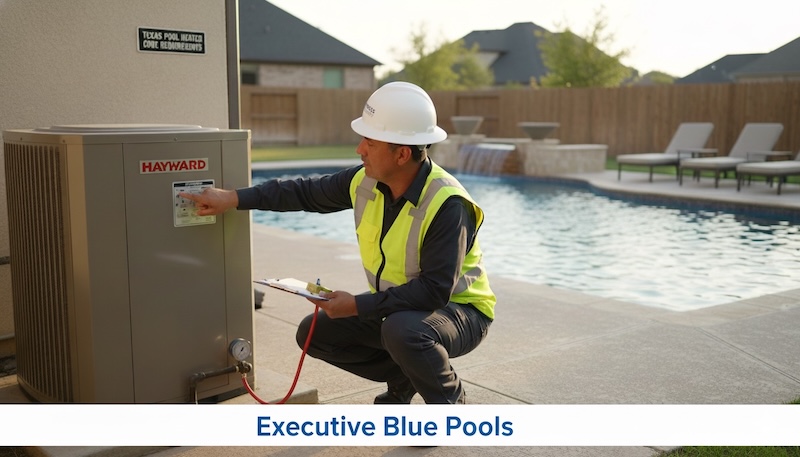
Executive Blue Pools is Frisco’s fully licensed and insured pool heater specialist that handles all permitting, code compliance, and inspection requirements for worry-free installations. Texas law requires specific permits, state licensing for pool work, RAIL electrical licensing, and minimum insurance coverage for pool heater installation and replacement. Through our professional pool heater services, we ensure every installation meets or exceeds Texas code requirements while protecting you from fines, voided insurance claims, and liability exposure.
Pool heater work in Texas isn’t just a plumbing job. It involves electrical connections that require RAIL licensing, gas line modifications that must meet combustion appliance codes, and structural considerations that trigger building permits. Many homeowners don’t realize that unlicensed work can void their homeowner’s insurance and create liability if something goes wrong.
Understanding these requirements helps you avoid hiring unlicensed contractors who cut corners and leave you exposed to thousands of dollars in fines and potential insurance claim denials.
Texas permit requirements for pool heater work
Most pool heater installations and replacements in Texas require a building permit from your local municipality. The permit process ensures that work meets safety standards for gas connections, electrical wiring, and combustion venting. Permits typically cost $50-150 and take 1-3 business days to approve.
New heater installations always require permits because they involve new gas line runs, electrical circuits, and structural modifications. Replacement installations require permits when you’re changing heater size (BTU capacity), relocating the unit, or upgrading electrical service from 120V to 240V. Even direct replacements often trigger permit requirements in many North Texas municipalities.
The licensed contractor pulls the permit, not the homeowner. This ensures that the work plan meets code requirements before installation begins. After installation, a municipal inspector verifies compliance and closes out the permit, which creates a permanent record that protects your property value and insurance coverage.
What triggers a permit requirement
- New installations: Any new pool heater added to existing pool requires full permitting
- BTU capacity changes: Upgrading from 200k to 400k BTU triggers new gas line sizing review
- Fuel type conversions: Switching from natural gas to propane (or reverse) requires new permit
- Location changes: Moving heater to different pad location requires structural and code review
- Electrical upgrades: Converting from 120V to 240V requires electrical permit
- Venting modifications: Indoor installations or vent terminal relocations need approval
Executive Blue Pools includes permit costs and handling in our installation quotes. We submit plans, coordinate inspections, and ensure final approval so you don’t have to navigate the municipal process.
RAIL electrical licensing requirements in Texas
Texas requires a RAIL (Residential Appliance Installation License) for any electrical work related to pool equipment, including heaters. This specialized license goes beyond basic electrical work and specifically covers residential appliance connections. Pool heaters require 120V or 240V electrical service, and improper wiring creates fire hazards and equipment damage.
RAIL licensing requires completing state-approved training, passing examinations, and maintaining continuing education. The license ensures technicians understand proper wire sizing, circuit protection, GFCI requirements, and grounding specific to outdoor wet locations. Many general electricians don’t hold RAIL licenses and can’t legally work on pool equipment in Texas.
Unlicensed electrical work on pool heaters voids manufacturer warranties and creates significant liability exposure. If a fire or electrical failure occurs and investigators discover unlicensed work, your homeowner’s insurance will deny the claim. You’ll also face municipal fines of $500-2,000 per violation if discovered during property sale inspections or insurance investigations.
What RAIL license covers
- Proper wire sizing for heater amperage requirements (typically 15-25 amps)
- Circuit breaker selection and load calculations
- GFCI protection requirements for outdoor wet locations
- Grounding and bonding for metallic pool equipment
- Conduit installation and weatherproof junction boxes
- Integration with pool automation systems (Pentair IntelliTouch, Hayward OmniLogic, Jandy AquaLink)
Executive Blue Pools maintains current RAIL licensing for all technicians who perform pool heater installations. We provide documentation of our license status with every quote and can supply copies for your records or insurance requirements.
Texas state pool contractor licensing
Texas requires state licensing for all pool construction, remodeling, and equipment installation work. This general pool work license covers the broader scope of pool systems beyond just electrical connections. The license demonstrates knowledge of hydraulics, water chemistry, equipment integration, and safety standards specific to swimming pools.
Licensed pool contractors must maintain bonds, carry specific insurance minimums, and complete continuing education on evolving safety standards like the VGB Act (Virginia Graeme Baker Pool and Spa Safety Act). The licensing board can investigate complaints and has authority to suspend or revoke licenses for safety violations or consumer complaints.
You can verify a contractor’s Texas pool work license through the Texas Department of Licensing and Regulation website. Licensed contractors will readily provide their license number and encourage verification. Unlicensed operators typically avoid discussing credentials or claim licensing doesn’t apply to repair work (it does).
License verification checklist
- Request license number: Ask for state pool contractor license number before getting quote
- Verify online: Check license status at Texas Department of Licensing and Regulation website
- Check expiration: Confirm license is current, not expired or suspended
- Review complaints: Look for unresolved consumer complaints or disciplinary actions
- Confirm insurance: Request certificate of insurance showing current coverage
- Ask for references: Licensed contractors can provide verifiable customer references
Insurance requirements for pool heater contractors
Texas doesn’t mandate specific insurance amounts for pool contractors, but most municipalities require proof of liability insurance to pull permits. Industry standard is $1M general liability coverage, though $2M is increasingly common for companies serving high-value homes in areas like Frisco, Plano, and McKinney.
Liability insurance protects you if the contractor damages your property, causes injury, or creates problems that emerge after installation. Without proper insurance, you become personally liable if a worker is injured on your property or if faulty installation causes damage. Your homeowner’s insurance won’t cover contractor negligence, leaving you exposed to potentially massive claims.
Always request a certificate of insurance before work begins. The certificate should list you as “additional insured” for the project duration, name your property address specifically, and come from an A-rated insurance carrier. Avoid contractors who claim they’re covered by your homeowner’s insurance (they’re not) or who can’t provide current certificates (they’re uninsured).
What proper insurance covers
- Property damage: Coverage if contractor damages pool equipment, hardscaping, or structures during installation
- Worker injury: Protection if installer is injured on your property during work
- Installation defects: Claims arising from faulty work that causes equipment failure or damage
- Gas line incidents: Coverage for gas leaks, explosions, or carbon monoxide exposure from improper venting
- Electrical failures: Protection if wiring errors cause fires, equipment damage, or electrical shock
Executive Blue Pools carries $1M+ liability coverage from A-rated carriers and provides certificates of insurance with every installation contract. We list clients as additional insured and ensure coverage remains current throughout the project and warranty period.
Venting and combustion safety codes
Texas follows International Fuel Gas Code (IFGC) for pool heater venting, which specifies clearances, materials, and termination requirements. Proper venting prevents carbon monoxide accumulation, ensures complete combustion, and protects your family from deadly gas exposure. Venting violations are among the most serious code failures because they create immediate life safety hazards.
Outdoor pool heaters require specific clearances from property lines, windows, doors, and air intake vents. Most codes require 4 feet from property lines, 12 inches from combustible materials, and 3 feet from forced air intakes. Indoor heaters (rare for pools but common for spas) require sealed combustion with dedicated vent pipes that prevent any exhaust from entering occupied spaces.
Inspectors specifically check vent terminal height, clearance measurements, and proper pitch for condensate drainage. Failed venting inspections require correction before approval, which delays project completion and can require expensive modifications if the heater location must change. Getting it right the first time requires understanding both state code and local amendments.
Critical venting requirements
- Minimum 7-foot clearance above ground level for vent terminals
- 4-foot horizontal clearance from property lines and adjacent structures
- 3-foot clearance from forced air intake vents (HVAC units)
- 12-inch clearance from combustible materials (wood fences, siding)
- Proper vent pipe sizing based on heater BTU capacity (typically 3-5 inches diameter)
- ¼-inch per foot pitch for condensate drainage away from heater
Consequences of hiring unlicensed contractors
Using unlicensed contractors for pool heater work creates serious financial and legal consequences that far exceed any money saved on the initial installation. Texas municipalities actively investigate unpermitted work through building department complaint lines, and neighbors often report suspicious activity when they see work crews without visible permits posted.
Municipal fines start at $500 per violation and increase to $2,000 for repeat offenses. Each code violation counts separately, so a single unpermitted installation can generate $2,000-5,000 in fines when inspectors find multiple issues with permits, electrical work, gas connections, and venting. You’ll also have to pay to bring the work into compliance, which often means tearing out and redoing the entire installation with licensed contractors.
Homeowner’s insurance companies routinely deny claims related to unpermitted or unlicensed work. If your pool heater causes a fire, gas leak, or carbon monoxide incident, investigators will check permits and contractor licenses. Discovering unlicensed work gives insurers grounds to deny the entire claim, leaving you personally liable for damages that can easily exceed $100k for fire damage to your home or neighboring properties.
Financial risks you face
- Municipal fines: $500-2,000 per violation (permits, electrical, gas, venting each count separately)
- Correction costs: $3,000-8,000 to tear out and redo work to code compliance
- Insurance claim denial: $50k-200k+ in fire damage not covered due to unlicensed work
- Property sale complications: Disclosure requirements and buyer inspection failures delay or kill sales
- Liability exposure: Personal responsibility for injuries or damages if contractor has no insurance
- Voided warranties: Manufacturer warranties require licensed installation (3-5 year coverage lost)
Beyond financial consequences, you face personal liability if unlicensed work causes injury or death. If a gas leak, carbon monoxide exposure, electrical fire, or explosion occurs, you can be held criminally negligent for knowingly hiring unlicensed contractors. This is especially serious if injuries or fatalities occur.
How to verify contractor compliance
Protecting yourself starts with thorough contractor vetting before signing any contracts or allowing work to begin. Legitimate contractors welcome verification and readily provide documentation. Unlicensed operators make excuses, claim regulations don’t apply to them, or pressure you to start work immediately without proper documentation.
Create a verification file with copies of licenses, insurance certificates, permits, and inspection approvals. This documentation protects you during insurance claims, property sales, and any future questions about code compliance. Legitimate contractors provide these documents proactively because they understand homeowner concerns and legal requirements.
Verification checklist before hiring
- State pool contractor license: Request license number and verify through Texas Department of Licensing and Regulation
- RAIL electrical license: Confirm current RAIL license for electrical work on pool equipment
- Insurance certificate: Obtain certificate showing $1M+ liability coverage from A-rated carrier
- Additional insured status: Ensure you’re listed as additional insured for project duration
- BBB rating: Check Better Business Bureau for rating and unresolved complaints
- References: Request 3 recent customer references for similar work
- Permit commitment: Get written confirmation that contractor pulls all required permits
- Warranty documentation: Verify that contractor is authorized dealer for brands being installed
Red flags include contractors who claim permits aren’t needed for replacement work, who offer significant discounts for paying cash (avoiding paper trail), who pressure immediate decisions, or who can’t provide documentation when requested. These behaviors indicate unlicensed operators trying to avoid oversight.
Executive Blue Pools compliance credentials
Executive Blue Pools maintains all required Texas licensing, insurance, and certifications for complete pool heater installation and repair work. We’ve served North Texas since 2013 with zero unresolved complaints and an A+ BBB rating, demonstrating our commitment to code compliance and customer protection.
Our comprehensive licensing and insurance provides peace of mind that your installation will pass inspection, maintain warranty coverage, and protect you from liability. We handle all permit applications, coordinate inspection scheduling, and ensure final approval before considering the project complete. You receive copies of all permits, inspection reports, and compliance documentation for your permanent records.
Our compliance credentials
- State-licensed: Current Texas pool contractor license for all pool equipment work
- RAIL electrical license: Specialized licensing for pool equipment electrical connections
- CPO-certified: Certified Pool Operator certification from Pool & Hot Tub Alliance
- IPSSA-certified: Independent Pool & Spa Service Association water chemistry certification
- CSP/PHTA certified: Certified Service Professional from Pool & Hot Tub Alliance
- $1M+ insurance: Full liability coverage from A-rated carriers
- Authorized dealer: Factory-authorized for Pentair, Hayward, Raypak, Jandy, and Sta-Rite
- Background checked: All technicians undergo background checks and regular drug testing
We provide insurance certificates listing you as additional insured with every installation contract. Our permit handling is included in quoted prices with no hidden fees. Most installations receive inspection approval on first attempt because we follow code requirements precisely and maintain positive relationships with local building departments.
Common questions about Texas pool heater codes
Do I need a permit to replace an existing pool heater in Texas?
Do I need a permit to replace an existing pool heater in Texas?
Yes, most Texas municipalities require permits even for direct replacement installations. The permit ensures that gas connections, electrical wiring, and venting meet current code standards, which often differ from standards in place when your original heater was installed. Licensed contractors handle permit applications and coordination with building departments.
What’s the difference between state pool license and RAIL license?
What’s the difference between state pool license and RAIL license?
State pool contractor license covers general pool equipment work including hydraulics, plumbing, and system integration. RAIL (Residential Appliance Installation License) specifically covers electrical connections for pool equipment. Both licenses are required for pool heater installation because the work involves both general pool systems and electrical wiring.
How much does a pool heater permit cost in Frisco?
How much does a pool heater permit cost in Frisco?
Frisco building permits for pool heater installation typically cost $75-125 depending on project scope and heater BTU size. The permit includes plan review and one inspection visit. Professional contractors include permit costs in their installation quotes so you don’t pay separately.
Can unlicensed work void my homeowner’s insurance?
Can unlicensed work void my homeowner’s insurance?
Yes, insurance companies routinely deny claims related to damage or injuries caused by unpermitted or unlicensed work. If your pool heater causes a fire, gas leak, or carbon monoxide incident, investigators check permits and contractor licenses. Discovering unlicensed work gives insurers grounds to deny the entire claim, potentially leaving you liable for $50k-200k+ in damages.
How long does permit approval take for pool heater installation?
How long does permit approval take for pool heater installation?
Most North Texas municipalities approve pool heater permits within 1-3 business days for straightforward replacement installations. New installations or complex projects requiring plan review may take 5-7 business days. Professional contractors submit applications early in the project timeline so permits don’t delay installation scheduling.
Compliant pool heater service in Frisco
Choosing a fully licensed and insured pool heater contractor protects you from fines, insurance complications, and liability exposure. Executive Blue Pools handles all permitting, maintains current licensing, and carries comprehensive insurance to ensure your installation meets Texas code requirements.
We’ve served Frisco and surrounding North Texas communities since 2013 with complete compliance on every installation. Our state pool contractor license, RAIL electrical license, and $1M+ insurance coverage provide the protection you need. We include permit costs and handling in our quotes with no surprise fees.
Schedule a consultation to discuss your pool heater installation or replacement. We’ll verify that your current system was properly permitted (many weren’t), explain code requirements specific to your situation, and provide detailed quotes that include all compliance costs. Our 4-hour response time and same-day diagnosis availability mean you won’t wait weeks to get started.
If you enjoyed this article, check out these other articles regarding Pool Heaters:
Pentair, Hayward & Raypak Heater Error Code Troubleshooting
Pool Heater Annual Maintenance Checklist for North Texas Hard Water